netcup Root Server Series Review & Specifications (AMD EPYC Zen 5 Dedicated Cores / 2.5 Gbps / NVMe)
- Core Positioning: Root Servers provide 100% dedicated physical CPU cores pinned exclusively to your instance with zero noisy-neighbor interference
- Hardware Platform: G12.5 features AMD EPYC 9645 (Zen 5 architecture), DDR5 ECC RAM, pure NVMe storage arrays, and a 2.5 Gbps network port
- Workload Policy: Permits 24/7 uninterrupted 100% CPU utilization with zero CFS time-slice throttling
- Disk Performance: Pure NVMe arrays deliver 80k–150k+ 4K random IOPS, ideal for high-concurrency OLTP databases
- Net Pricing: Starts at €9.24/mo net (0% VAT for non-EU & EU B2B Reverse Charge; +19% VAT for German consumers), plus 1–2 free months via voucher codes
Table of Contents9 sections
First-time visitors to netcup often wonder what "Root Server" (RS series) actually means: is it a standard VPS or a bare-metal dedicated server? And why do experienced sysadmins always prioritize RS deals during major promotions even when the core count looks similar to a VPS?
In short, a netcup Root Server sits right between a shared VPS and a bare-metal dedicated server: it runs on KVM virtualization, but the hypervisor pins dedicated physical AMD EPYC CPU cores and DDR5 ECC RAM exclusively to your instance, while keeping cloud advantages like instant snapshots, browser VNC, custom ISO mounting, and online scaling.
Below, we examine the hardware isolation architecture, full G12.5 net pricing tables, and the four workloads where an RS server dramatically outperforms a shared VPS.
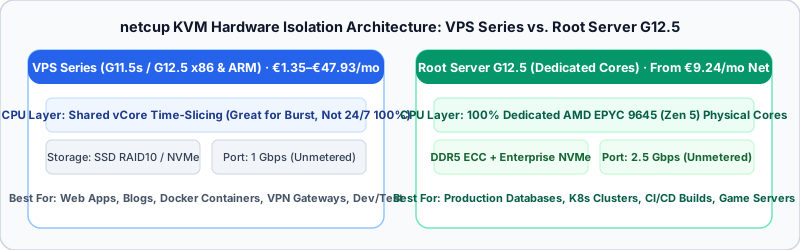
1. Architecture Comparison: Root Server vs. Shared VPS vs. Bare-Metal Dedicated#
Comparing a netcup Root Server side-by-side with a Shared VPS and a Traditional Bare-Metal Dedicated Server makes the architectural trade-offs clear:
| Dimension | Standard VPS (Shared vCore) | Bare-Metal Dedicated Server | netcup Root Server (RS) |
|---|---|---|---|
| CPU Allocation | Shared virtual cores (vCore) Multiple VMs time-share physical cores | Exclusive ownership of the entire physical chassis | Dedicated Physical Cores Pinned physical cores with zero neighbor contention |
| 24/7 100% CPU Load | Not permitted long-term Multi-hour 100% load triggers CFS deprioritization | Permitted 24/7 Full hardware control | Permitted 24/7 at 100% Compile, transcode, or run batch jobs nonstop without throttling |
CPU Steal (%st) | Subject to neighbor bursts Occasional %st jitter at peak hours | None | Virtually Zero Jitter%st remains at 0.0% continuously |
| Storage Media | Enterprise SSD RAID10 (~15k–35k IOPS) | Raw disks; drive failure requires manual ticket & replacement | Enterprise Pure NVMe Array (~80k–150k+ IOPS, ultra-low latency) |
| Network Port Speed | 1 Gbps | Typically 1 Gbps | 2.5 Gbps port standard across all tiers |
| Cloud Management | Snapshots, VNC, online scaling | No snapshots; slower provisioning & rescue | Full Snapshots, HTML5 VNC, Custom ISO & Block Storage |
The Bottom Line:
Root Server = Dedicated physical EPYC cores & pure NVMe IOPS + Cloud snapshots, VNC console, and on-demand scalability.
2. RS G12.5 Full Specifications & Net Pricing Table (2026 Lineup)#
With the G12.5 generation, netcup upgraded the entire Root Server line to AMD EPYC 9645 (Zen 5 architecture) enterprise processors paired with DDR5 ECC memory and pure NVMe storage.
All prices below are 0% VAT net prices for non-EU customers (US, UK, CA, AU, SG, etc.) and EU businesses with a valid VAT ID via Reverse Charge (private customers in Germany add 19% VAT):
| Model | Dedicated Cores (AMD EPYC 9645) | Memory (RAM) | Storage (Pure NVMe) | Network Port | 1-Month Net | 12-Month Net (~13% Off) | 24-Month Net (~26% Off) |
|---|---|---|---|---|---|---|---|
| RS 500 G12.5 | 2 Dedicated (Zen 5) | 4 GB DDR5 ECC | 64 GB NVMe | 2.5 Gbps | €12.49 | €10.87 | €9.24 /mo |
| RS 1000 G12.5 | 4 Dedicated (Zen 5) | 8 GB DDR5 ECC | 128 GB NVMe | 2.5 Gbps | €21.00 | €18.26 | €15.54 /mo |
| RS 2000 G12.5 | 8 Dedicated (Zen 5) | 16 GB DDR5 ECC | 256 GB NVMe | 2.5 Gbps | €39.33 | €34.20 | €29.10 /mo |
| RS 4000 G12.5 | 12 Dedicated (Zen 5) | 32 GB DDR5 ECC | 512 GB NVMe | 2.5 Gbps | €75.21 | €65.40 | €55.66 /mo |
| RS 8000 G12.5 | 16 Dedicated (Zen 5) | 64 GB DDR5 ECC | 1 TB NVMe | 2.5 Gbps | €143.43 | €124.72 | €106.14 /mo |
| RS 12000 G12.5 | 20 Dedicated (Zen 5) | 96 GB DDR5 ECC | 1.5 TB NVMe | 2.5 Gbps | €209.60 | €182.26 | €155.10 /mo |
| RS 16000 G12.5 | 24 Dedicated (Zen 5) | 128 GB DDR5 ECC | 2 TB NVMe | 2.5 Gbps | €279.73 | €243.24 | €207.00 /mo |
Note: Just like the VPS series, Root Servers offer 1-month, 12-month (~13% off), and 24-month (~26% off) contract periods, plus hourly billing options and netcup's 30-day satisfaction guarantee. High-capacity RS 12000 and RS 16000 configurations are provisioned on request.
3. Four Killer Use Cases: Why Choose a Root Server?#
Use Case 1: Multiplayer Game Servers (Minecraft / Palworld / CS2 / Rust)#
- The Problem on Shared VPS: Game servers rely on a tight real-time tick loop (e.g., 20 TPS in Minecraft or 64/128 tick in CS2). Even if your average CPU utilization is only 30%, a neighboring VM on a shared host running a heavy
git cloneor archive extraction can cause millisecond-level CPU scheduling jitter, resulting in rubber-banding, packet loss, or"Can't keep up! Is the server overloaded?"warnings. - The RS Advantage: Dedicated Zen 5 cores eliminate multi-tenant contention completely. High single-thread clock speeds keep every game tick deterministic for dozens or hundreds of concurrent players.
Use Case 2: Production OLTP Databases (PostgreSQL / MySQL / Redis)#
- The Problem on Shared VPS: High-concurrency transactional databases are sensitive to disk I/O latency. Standard SSD RAID10 arrays typically deliver 15k–35k 4K random write IOPS, which can queue up during heavy WAL flushes or backup jobs.
- The RS Advantage: Pure NVMe arrays on Root Servers consistently achieve 80,000 to 150,000+ 4K random IOPS with microsecond-level latency, paired with dedicated DDR5 ECC RAM for large InnoDB/PostgreSQL buffer pools.
Use Case 3: Private Hypervisor & Nested Virtualization (Proxmox VE)#
- The Problem on Shared VPS: Many budget VPS providers disable nested virtualization (
SVM/VT-x), or secondary VMs suffer severe overhead. - The RS Advantage: Root Servers expose hardware-assisted AMD-V nested virtualization instructions. You can mount the official Proxmox VE (PVE) ISO directly via the SCP panel and partition your RS into dozens of isolated LXC containers and KVM virtual machines.
Use Case 4: 24/7 CI/CD Build Runners, Media Transcoding & Distributed Nodes#
- The Problem on Shared VPS: Multi-hour Rust/Chromium builds, FFmpeg H.265/AV1 batch encoding, or Elasticsearch indexing will trigger CFS fair-use throttling on shared vCores.
- The RS Advantage: Your dedicated cores belong to you 24/7. You can run all cores at 100% utilization for weeks on end with zero throttling.
4. vGPU Root Servers (NVIDIA H200 for AI & CUDA)#
For AI inference, fine-tuning, and GPU-accelerated rendering, netcup also offers vGPU Root Servers:
- Equipped with dedicated slices of enterprise NVIDIA H200 Tensor Core GPUs (such as RS 2000 vGPU 7 and RS 4000 vGPU 14).
- Full hardware pass-through for CUDA and TensorRT, ready for self-hosted Llama 3 / DeepSeek inference endpoints, Whisper transcription, or Stable Diffusion pipelines.
- Eligible for €5 new-customer vouchers and promotional deals listed on our Active Vouchers Page.
5. Final Sizing Verdict#
- For standard websites, blogs, lightweight Docker apps, or staging: A VPS 500 / 1000 G12.5 is more than sufficient and keeps monthly overhead low.
- For multiplayer game servers, production databases, Proxmox VE hypervisors, or 24/7 heavy compute: Step up to a Root Server (starting with RS 1000 or RS 2000 G12.5 on a 12- or 24-month term, paired with a free-month voucher code). The jump to dedicated AMD EPYC Zen 5 cores, pure NVMe storage, and a 2.5 Gbps port is night and day.